Thursday, December 08, 2011

The Old Typewriter

It's like this. I accepted a challenge over at Facebook,  from Becca Harris of  Bony Fingered Limbs --- to write a 1,500 word story about an old typewriter. It's due in five minutes, so I guess I'd better do some quick copying!


Good Luck
by Sandra Leigh

Nancy found the old typewriter at an estate sale about two hours outside of town. In front of a Victorian farmhouse, there were tables covered with clean, pressed linens, mismatched china, and -- sitting on an old spool-back wooden chair -- the typewriter. When Nancy gave the space bar a tentative push, it worked. Tap-click. On a whim, she bought the typewriter, the spool-back chair, and one of the nicer tablecloths, one that must have been an heirloom. Something told her that the typewriter – that everything she had bought, for that matter – was filled with good luck, and she needed some.

Now, the old typewriter sat on her dining room table, surrounded by piles of paper, coffee cups whose contents had congealed into something like gum, and crumpled, unsavoury Kleenex. Beside the typewriter was the Dell laptop that Nancy actually used for writing. The old typewriter was there for inspiration – and for luck, of course. Nancy herself sat slumped on the old spool-back chair. Neither the old typewriter nor the chair appeared to be bringing her luck – at least, not the good kind. "Bugger!" said Nancy. She could swear at will. There was nobody to hear her. Nancy lived alone, by choice. She didn't want a husband, didn't like kids, and she had seen too many literary careers derailed by the demands of family to take the risk herself. She would succeed or fail according to her own lights, and by her wits.

Nancy had a deadline. She also had a cold, and it was a bad one. Her current book, a Gothic romance complete with flickering candles and a hero on horseback, was just beginning to take shape, but now she was under attack by a rhinovirus, and her wits were failing her. She soldiered on, blowing her nose after every sentence, then re-reading the sentence, because blowing her nose made her forget what she had just written. Once in a while, she would allow herself to wallow for a moment in her misery, her head resting on her bent right arm, her left arm draped over the old typewriter, tears streaming down her face. Of course that only made her runny nose worse than ever, so she was trying hard not to do it anymore. "Come on, girl," she said aloud. "Just write, dammit!"

She took a deep breath, coughed, and read her last sentence again: "Rebecca heard a sound – nothing more than a whisper, really – coming from behind the velvet draperies." Nancy paused, her hands poised over the laptop's keys, while she considered what to say next. What was the sound, she wondered? Was Rebecca imagining it? Was it real? Was there someone else in the room? She waited for the story to unfold, enjoying the wait, as always. This was her favourite part of writing. She blew her nose again, then closed her eyes, shutting out the world, moving into her imagination, searching for answers. When that didn't help, she moved over to the old typewriter and hovered there, thinking.

A sound intruded on Nancy's thoughts. It was no more than a rustling– and it came from behind the draperies. A shudder passed over her. She took her hands off the keys and backed her chair away from the old typewriter, shutting the laptop as she went. She stood and ran for the doorway, flipped the light switch, flooded the dim room with yellow light from the electric chandelier that hung over the dining table. Then she stood, her back against the wall, her story forgotten, trying to slow her breathing and steady her heartbeat. Count to ten, she thought. She got as far as six. Then the curtains moved, and she heard another sound – a kind of whimper. A whimpering ghost? A whimpering burglar? She sidled along the wall, moving as quietly as her laboured breathing would allow, keeping her eyes on the curtains. As she passed the fireplace, she took a brass candlestick down from the mantel. Thus armed, she approached the window. The draperies were still, now, as if holding their breath. She reached out with her left hand and swept them aside while she raised her right hand, which held the candlestick.

"Don't hit me. Please don't hit me." The child cowered, raising his arms to shield his face. He wasn't more than seven years old. Stringy blond hair hung over his eyes. He shivered in torn jeans and a dirty tee shirt.

Nancy lowered the candlestick. "Who are you?" she said. "What are you doing in my house?"

"I didn't take anything!"

"That's good, but why are you here? And how did you get in? And who are you?"

"Jimmy. Through the living room window."

"Jimmy who?"

"Jimmy Baldwin. I – I just needed a place to get warm, honest. It's cold. I didn't know anybody was home."

"But why were you out in the cold dressed like that? Where is your coat? Where are your parents?"

Nancy set the candlestick back on the mantel and motioned for Jimmy to come away from the window. It was warmer in the centre of the room. She pointed to a chair. "Sit." He sat. She went to the living room and pulled an afghan off the back of the sofa, brought it into the dining room, and wrapped it around Jimmy. "Wait here," she said. "I'll get you something warm to drink." She had made ginger tea to sip while she worked. That would warm him up. She poured some into a mug, added a dollop of honey, brought it back, handed it to him.

"Thank you."

"You're welcome. Now tell me what you were doing outside in the cold with no coat."

Jimmy looked down at the floor. Nancy could see his lower lip quivering as he fought back tears.

"I won't hurt you. I promise. Just tell me, okay?"

Jimmy's right foot traced a pattern on the floor, but he didn't speak. After a minute, Nancy turned and reached for her phone, which she had left on the table. "Okay, I'll call the police. They can make sure you get home safely."

"No! Please don't!" He grabbed Nancy's hand and held on.

"If you won't tell me what's going on, Jimmy, I don't really have any choice."

"If I tell you, will you let me stay here?"

"Uh, no. I'm sorry. First of all, I like living alone, thank you, and second, I could get into a lot of trouble if I kept you here."

"I wouldn't tell anybody."

"No, I don't imagine you would. But the answer is still no." Nancy pulled two warm jackets from the closet, handed one to Jimmy, and put the other one on. She grabbed a Kleenex from the box on the table, then changed her mind and grabbed a whole handful. She opened the front door and pointed outside. Jimmy obeyed, but his feet were dragging. She took his hand and walked with him to the end of her walkway. "Now let's get you home. Where do you live?"

"Never mind," he said. "I can get home on my own."

"Nope. You can't. You're – what? Six? Seven?"

"I'm going on eight!"

Nancy looked down at the boy and sighed. She put her hand on his shoulder, turned him around, and led him back into her house. She went to the kitchen and pulled a can of tomato soup out of the cupboard. While it heated, she made two peanut butter and jam sandwiches. She poured the soup into mugs, set the sandwiches on plates, and carried the makeshift supper into the dining room, where Jimmy still stood. He still wore her jacket, and it hung down past his knees.

"Dinner's served," said Nancy.

"Thank you," said Jimmy.

When Nancy lifted the jacket from Jimmy's shoulders, he flinched. "Before you eat, put on a clean shirt," she said. She found a tee shirt in her dresser. It was too big, but it would serve. Back in the dining room, she took hold of Jimmy's shirt and pulled it over his head. As she suspected, there were bruises on his chest and back. He folded his arms over his chest, hiding. "Here. Put this on," said Nancy.

They ate in silence. After dinner, Nancy put a sheet of paper in the old typewriter. She brought a high stool and helped Jimmy climb up. "Can you read?" He nodded.

"Good. You write your story – take your time – and I'll write mine. Deal?"

"Deal. But won't you get into trouble?"

"Nah. I'm a very lucky lady. Don't worry. Everything will be fine."

Jimmy looked down at the keys, then back at Nancy. Smiling, he started to hunt and peck. Nancy looked over at him, shrugged her shoulders and blew her nose. "What the hell," she said, "Maybe my luck is changing," and she went back to work.

Friday, September 23, 2011

A Canadian Turtle on the Oxford Canal 
(a Meandering, Catching Up sort of post)

That's not exactly The Turtle in the photograph. It's the Prince of Caversham, the narrowboat we rented from Caversham Boat Rentals near Reading.  We have been on board for two weeks, and we haven't had access to wi-fi since the first day. Not only that, but the trip has been fraught with Perils and Frustrations and Adventures -- also Joy and Happiness and the Pain of Parting.

I had neither time nor energy to write until the night before last, when I decided I had better start writing things down before they all got jumbled in my head (too late! too late!) Never mind. I'll copy down what I've written over the last couple of days, and later on, I'll fill in the huge gap in my narrative that is the last two weeks.

Thursday, September 22, 2011

We spent last night at Braunston (on the Grand Union Canal), having been delayed there by a lock malfunction. There were two boats (ahead of us) stuck in one of Braunston's seven locks. A paddle had come loose from its track, so it was impossible to empty the lock.

By the time British Waterways arrived and repaired the lock, it was really too late to go anywhere. Meanwhile, Erin and I walked into town - - straight uphill, as I recall -- bought about forty pounds of groceries, and lugged them home to the boat in our backpacks. We arrived at the canal just in time to see Robin (and our boat!) leaving in search of a mooring place. We flagged Robin down, climbed aboard, and collapsed.  It was all we could do, any of us, to stay up until bedtime, and bedtime is remarkably early on this trip. Nine o'clock seems to be the witching hour, and nobody gets up until just before seven in the morning, when I roll out of bed and make the first pot of coffee.

First thing this morning, we left Braunston and headed for the Oxford Canal. We had been warned to stock up on supplies and make sure we had plenty of water, diesel, and calor gas (propane), because such niceties would be hard to come by on the Oxford -- so shortly after turning onto the Oxford, we stopped for diesel, water, and calor gas at Napton Marina in Stockton.

We drove into a berth at the marina. Nobody appeared to help us. I walked up to the office and interrupted the lady who was sitting at a desk, chatting on the phone. I asked about buying diesel, and she said "The men are on tea break, but they'll be back in about ten minutes." I thanked her. She went back to her conversation. We waited. By the time we left the marina, we had bought four tea towels (Canal shops sell the best tea towels in the world!), diesel, and calor gas. We had filled the water tank and pumped out the unmentionable. A friendly but unsmiling gentleman did that last job for us, and in the process he noticed that the clip holding our centre line onto the roof was ready to snap, so he replaced it. Already, we have had reason to be grateful for his powers of observation.

On the way out, we picked up a couple of leaflets advertising the narrowboats that we could rent from Napton Marina -- elegant vessels, all. As far as I know, the lady in the office was still chatting on the telephone.

We got as far as Napton, where we discovered that we wouldn't be able to go past Lock 15 that night because its hours of operation were restricted to four hours a day -- 10 a.m. to 2 p.m. -- and by the time we got there it would be too late. The restrictions were  due to water shortages in this part of the country. We were at Lock 8. Our informant told us that we could moor in the pound just before Lock 15, but we would be in the middle of nowhere -- so we moored just after Lock 8 and walked into the village for provisions and just to have a look around.

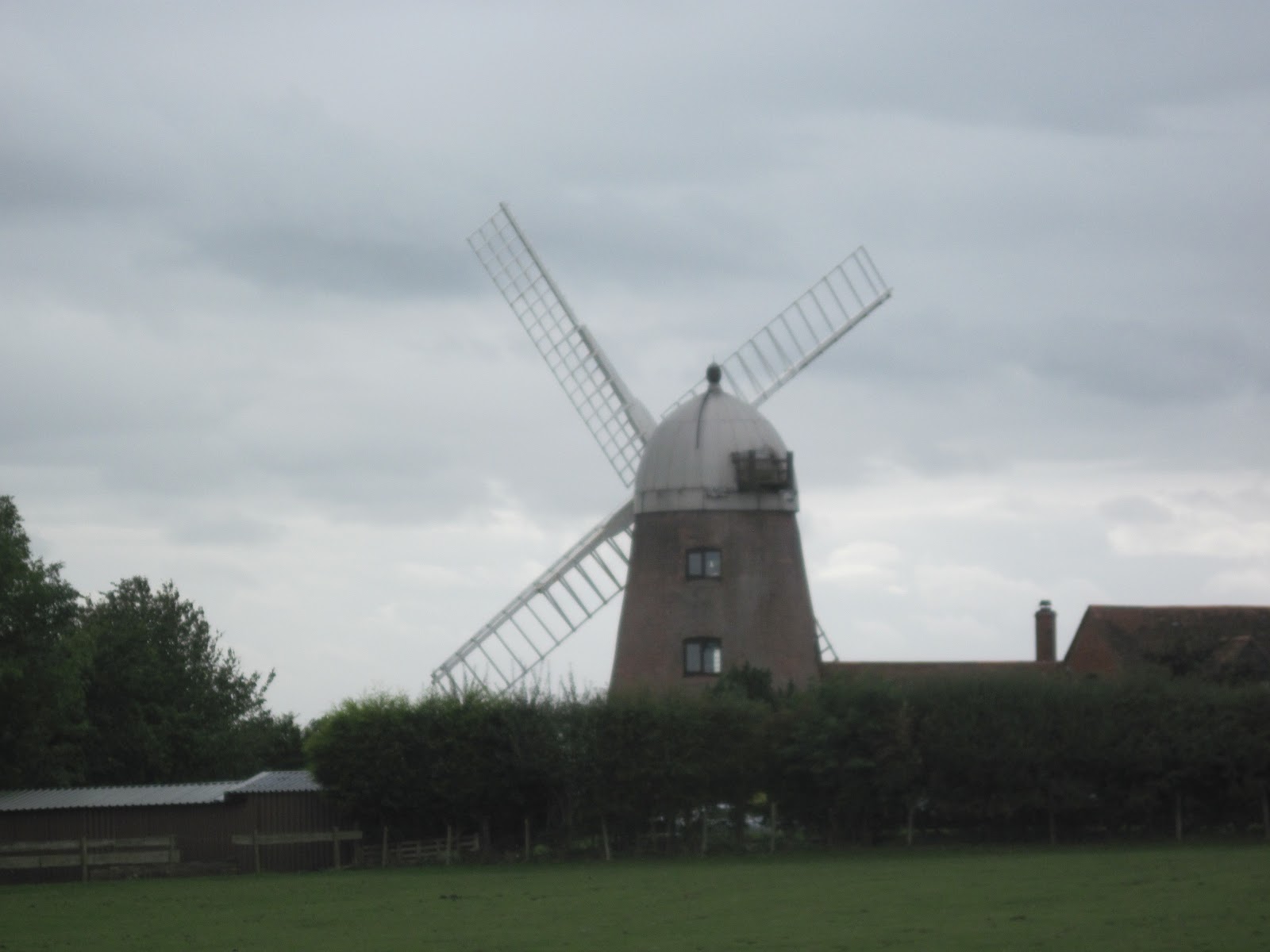
We went to the local grocery store, bought a few things, and then went in search of the windmill that overlooks the town. We took the long way. I discovered a place to buy free range eggs. Erin found a sheep to pet, which made her day. Robin got to stretch his legs. The windmill is privately owned, but we were able to get pretty close -- close enough for photos. On the way back, we saw a small herd of Highland cattle. I noticed a sign on the fence that listed each cow's identification nuber and name, so I stopped to look at it. There was a smaller sign beside it that gave the name of the farm in English and Gaelic, but it was partially obscured by foliage. Erin pulled the plants aside to show me the sign. I asked whether she was aware that the plant she held was stinging nettle. No, she didn't -- not yet. So we had a lesson in the medicinal qualities of dock (plantain), which fortunately tends to grow near stinging nettles. In the excitement, I forgot to take a picture of the cattle.

By the time the three of us got back to the canal, two hours had passed. We popped into the pub (The Folly). Erin had discovered the shandy, so I ordered one for her, made with bitter. She loved it. We came home, prepared and ate dinner, then went out again. Erin had been reading a brochure about Warwickshire, and it made mention of a 13th Century Norman church in Napton -- one that comes with a legend. The legend is that the church was originally built down on the village green, but one night the devil himself disassembled the church and carried it, stone by stone, to the top of the hill, where he reassembled it. We could see the church from our boat, but somehow we had missed it on our two-hour walk. So Erin and I set out again,  leaving Robin at the boat. This time, we din't do a circuit of the village. We kept the church in sight and just took the shortest route we could find. We were halfway up the hill when we lost sight of the church. We went into The Crown (Napton's other pub) and asked directions. "Go out the pub, turn left, and go straight up. You can't miss it."  Straight up, indeed. We deciced that the legend had been made up by some disgruntled parishioner who resented his Sunday climb. The church -- St. Lawrence's -- was quite near the windmill,  but to reach it you have to climb a narrow path that really should come equipped with rungs. We were winded, but we persevered, and we were glad of it. The churchyard was fascinating, as churchyards generally are. We found a small marble angel and a wooden cross that had been knocked over, so we righted them. We took pictures of the church. We were about to leave when I decided to try the door -- not that there was a chance it would be open. It was. So we went inside. Dusk was approaching, and there wasn't much light in the church, but we explored it as well as we could manage. Erin found (a piece of) a German land mine that was serving as a memorial. I found a sign near the door that read "If you feel so desperately in need that you have to steal from this church, please ask for help and we will try to give it." We had a couple of coins in our pockets, so we left those in the poor box in gratitude for the trust. I can't remember the last time I found a church open and unattended at dusk on a Thursday. We got back to the boat with the last of the light. This second excursion had lasted just over an hour.

Oh, but wait! I nearly forgot to tell about our third adventure -- the one that came between the two walks. Erin and I were making soup. Robin had gone back to the pub. We were working, chatting, having a cup of tea -- and something didn't feel right. Then I heard a strange noise. I went to the stern and opened the door. A man who was walking along the towpath said "I believe you are adrift." I turned and saw that our bow line had come loose. The bow was over on the other side of the canal. I called to Erin, who came out the bow door to find herself in a tree. The gentleman on the path took the centre line that I threw him (the one that had been ready to snap) and pulled us back to shore. The bow pin had come out of the soggy ground. Fortunately, we had tied up by threading the line through the pin's eye and bringing the line back to the boat, so the pin was still attached to the line. I got out the hammer, disengaged the pin, hammered it back into the ground, and tied it again. Meanwhile, Erin had come out and taken over the centre line so that our rescuer could go in his way. As I finished, reattaching the bown line, Erin told me I had better go deal with the stern line,  because it was about to come out of the ground -- so I performed the same operation at the stern. All of this was made difficult by the fact that the head flew off the hammer every four or five strokes.


Never mind. By the time Robin got home, all was in order, and I was thinking very kind thoughts about that unsmiling man back at Napton Marine. If not for him, our adventure might not have had a happy ending.

Sunday, July 10, 2011


On the road and loving it...

We are in Port Townsend, Washington, sitting at Point Hudson RV Park, which is right on the water and within five minutes' walk of my favourite bookstore, William James, Bookseller. I went in there this afternoon and picked up a copy of Barbara Kingsolver's Homeland and Other Stories. I thought that was very controlled of me. I generally have trouble getting out of there with fewer than five books. I've found the secret. I didn't look beyond the sale shelf near the front door -- but I'm regretting that now. We've had a lovely time here, catching up on news with Angel May and Angel Spouse, enjoying Port Townsend as always, but we will be leaving tomorrow morning, headed for the other side of Port Angeles -- to visit Roger and Chantal, old friends that we met in Mexico.

Yesterday  I went into a bookstore called Imprints. I bought a birthday card for my sister and a copy of Anne of Green Gables for my great-niece. I asked directions to the post office. The proprietor pointed me to a shop called the Purple Heron, down at the other end of the main street, where there is a little postal outlet.  I walked down there, confirmed that they could mail my packages, and asked for the padded envelopes I would need.  Unfortunately, the young lady at the counter told me, they had run out of the envelopes. I should keep on walking to Don's Pharmacy, where I could buy them.  So off I went -- but I stopped, halfway out the door. I think I said that I would find a place to sit and inscribe the book with my fountain pen, and then I would buy the envelopes and come back. Before I could get the door closed, the young lady said,

"Excuse me, but what's a fountain pen?"


Oh, dear. I felt immensely old.

I went back to the counter, pulled the pen out of my purse, and showed it to her. I gave her a brief history of the fountain pen, beginning with the quill. I told her that a fountain pen's nib forms itself to the handwriting style of its user. I showed her how to fill the pen.  She was enthralled. "I have to have one of those," she said. So I wrote down the URL for xFountain Pens. I made to leave again, but again I hesitated at the door. "Oh," I said, "I should tell you that it can be difficult to fill the pen directly from the ink bottle. You might want to use something like an egg cup as an inkwell. That makes it much easier."  I looked at her, and even before she spoke, I knew just what she was going to say.

"What's an egg cup?"